Lavassaare – part of Europe’s wetland restoration
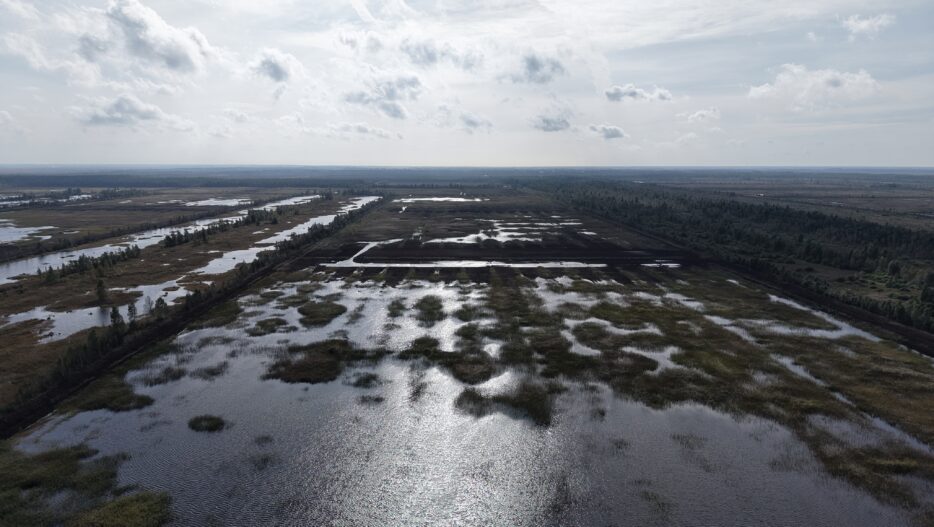
In Lavassaare, Estonia, 525 hectares of former peat production land are being turned back into wetland. The work is part of the EU-funded WaterLANDS project, which is testing how wetlands can be restored at scale across Europe.
525 hectares of new wetland
In the Lavassaare and Elbu areas, approximately 525 hectares of former peat production areas managed by Tootsi Turvas are being restored. The aim is to restore the hydrology of the areas and create conditions in which wetland ecosystems and their characteristic vegetation can gradually recover.
Approximately 8.3 kilometres of water-retaining embankments, 63 dams and 38 overflow structures have been constructed in the area. In addition, around 209,000 cubic metres of soil has been moved to fill and level ditches.
Following the technical restoration work, the focus is shifting to supporting the recovery of vegetation. The aim is to gradually restore the natural processes that enable wetland ecosystems to function.
Why restore wetlands now?
The work in Lavassaare is part of a broader transition taking place across Europe. Most wetlands and protected habitats in the EU are in poor condition. This matters because healthy peatlands store carbon, regulate water and help landscapes cope with droughts and floods, as well as supporting biodiversity.
The EU Nature Restoration Regulation sets a clear goal for 2030: Member States must restore an area equal to at least 30% of their drained agricultural peatlands. At least one quarter of this area must be rewetted. Restoring former peat production areas can also help countries reach this target.
Member States are putting these targets into practice through their national restoration plans. Projects such as Lavassaare show how this works in practice, providing experience and continuous monitoring data on large-scale restoration carried out jointly by landowners, businesses, researchers, authorities and local communities.
Part of a European solution
WaterLANDS brings together six large-scale restoration sites across Europe. The project develops and tests approaches for restoring wetlands on a larger scale while also supporting local communities and economies.
The final General Assembly of the WaterLANDS project was held in Venice, where the project partners shared results and lessons from large-scale wetland restoration.
A recent WaterLANDS Policy Brief emphasises that wetland restoration is about more than nature conservation: it can also improve water security, help regions adapt to climate change and support rural economies. This can also be seen in Lavassaare and the restored area will also be opened up to visitors.
The responsibility for land does not end when production does. Former peat fields are well suited to becoming wetlands again, and rewetting them benefits biodiversity, water management and the climate at once.
The work does not stop here in Lavassaare. Tootsi Turvas plans to restore a further 423 hectares over the next few years.
More information: https://waterlands.eu/
Watch the video: Restoring Europe´s Wtlands