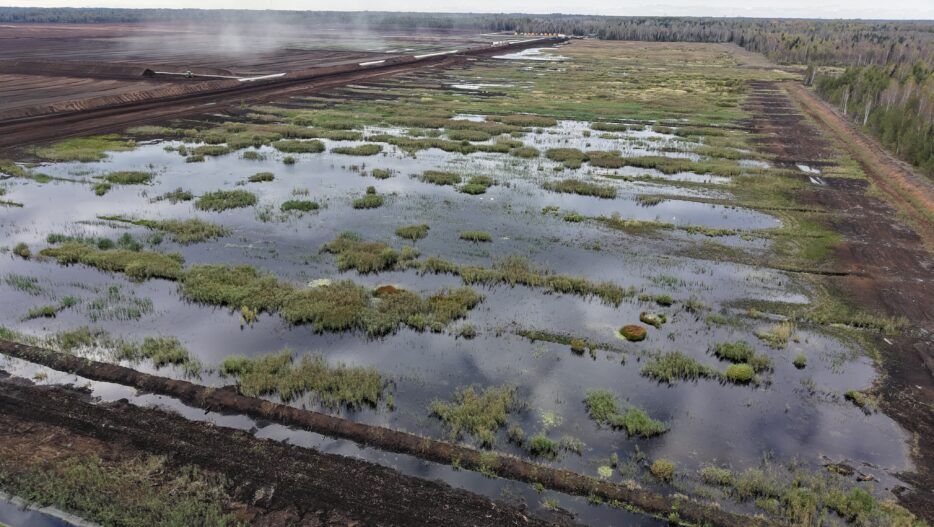
Neova restores extensive peat production areas in Estonia
Neova’s subsidiaryTootsi Turvas is actively restoring large areas of exhausted peat harvesting fields in Estonia. The restoration work has been significantly supported by the EU-funded WaterLANDS project, which focuses on wetland recovery across Europe.
Historically, peat has played an important role in Estonia, evolving from a primary fuel source to a key material in horticulture. However, abandoned peat fields do not recover naturally; they often remain dry, vegetation-free, and pose environmental risks such as fire hazards and greenhouse gas emissions. Therefore, peat producers are legally required to restore these areas.
The restoration process mainly involves rewetting the land by blocking drainage systems and stabilizing water levels. This enables vegetation to regrow, starting with species like reeds, and gradually leads to the return of biodiversity. Improvements can already be seen within a year, while full ecological recovery—where the area becomes a carbon sink again—takes about 5–10 years.
Large-scale restoration work is underway in Lavassaare, where nearly 1,000 hectares of former peat harvesting areas are being restored, partly funded by the WaterLANDS project. Other sites across Estonia are also being restored by Tootsi Turvas, even though the company did not originally exploit all of these areas.
Despite the relatively simple technical work, restoration is slowed by complex and lengthy administrative procedures, including permits, environmental assessments, and approvals. Compared to countries like Finland, Estonia’s regulatory framework is more bureaucratic.
Costs of restoration vary depending on site conditions, ranging from a few hundred to around 900 euros per hectare. Challenges include poor soil nutrient content, and debates over using wood ash as a soil amendment, which is currently restricted in Estonia but used in Finland.
Overall, the key factor in successful restoration is water: once water levels are restored, vegetation returns, wildlife reappears, and previously degraded landscapes can recover into functioning wetland ecosystems.
This is a summary of an article published in the Estonian nationwide newspaper Postimees on 2 June 2026.
Link to the article: https://majandus.postimees.ee/8483710/tootsi-turvas-puhub-ammendunud-turbavaljadele-elu-sisse