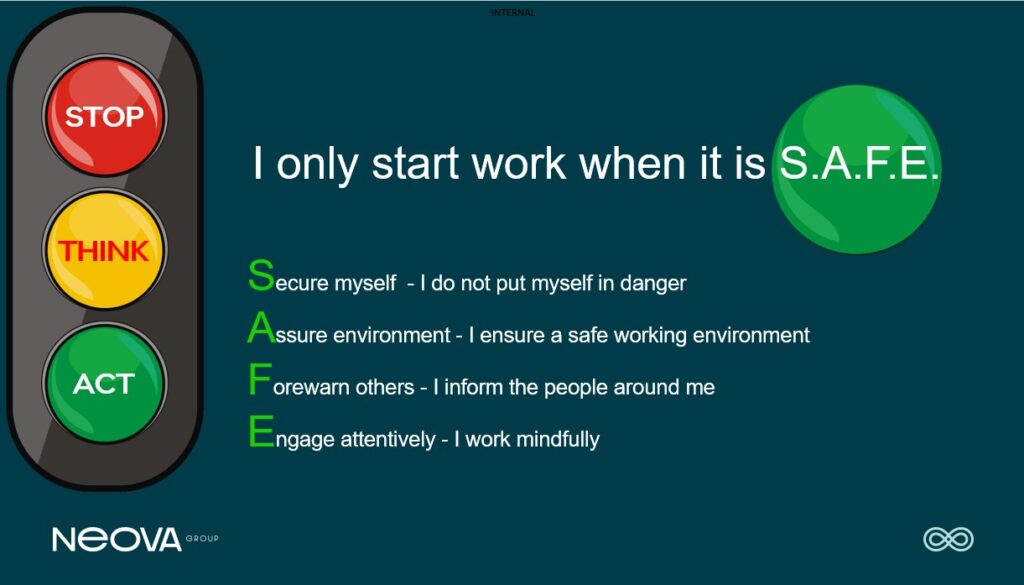
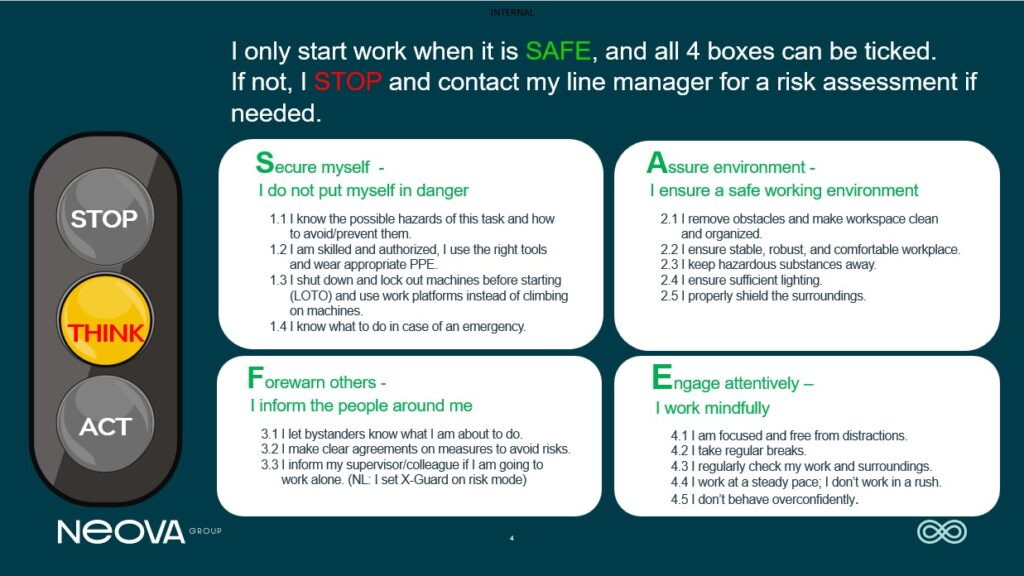
EXPLANATION OF THE S.A.F.E. PRINCIPLES
Each letter stands for a concrete action. The line manager ensures these principles are regularly discussed and applied:
S = Secure myself – I don’t put myself in danger. I know the risks (collision, fall, entrapment, electrical, fire) of my task and how to avoid them. I only perform tasks I’m authorized for, wear the correct PPE, and use proper tools. I apply LOTO and work safely at height. I know what to do in emergencies.
A = Assure environment – I ensure a safe working environment. I remove obstacles, keep the workspace clean and organized. I work on a stable and comfortable surface, keep hazardous substances at a safe distance, ensure proper lighting, and shield risky zones.
F = Foreworn others – I inform the people around me. I let bystanders know what I’m going to do and make clear agreements about safety measures. I report when I work alone.
E = Engage attentively – I work attentively and without distractions. I take regular breaks, check my work and surroundings, work at a calm pace, and stay alert. I avoid reckless behavior.
What is expected from the line manager
- Actively discuss these principles in team meetings and toolbox sessions.
- Recognize and highlight behavior that aligns with S.A.F.E.
INTRODUCTION AND AWARENESS
What is expected from the line manager
- Ensure visual reminders with the S.A.F.E. message are visible in your department.
- Repeatedly mention the slogan “I only start work when it’s SAFE” and discuss the four pillars during team meetings.
- Lead by example by actively referring to S.A.F.E. in daily conversations.
TRAINING AND REPETITION
That is expected from the line manager
- Organize short toolbox meetings focused on S.A.F.E.
- Regularly repeat the S.A.F.E. principles and integrate them into existing safety instructions.
- Ensure new employees are introduced to S.A.F.E. from day one.
MONITORING AND FEEDBACK
What is expected from the line manager
- Actively seek feedback from employees on the applicability of S.A.F.E.
- Use incidents or near misses as learning moments and discuss how S.A.F.E. could have helped.
- Track how often S.A.F.E. is applied and mentioned within the team.
EMBEDDING IN CULTURE
What is expected from the line manager
- Integrate S.A.F.E. into onboarding for new employees.
- Link S.A.F.E. to existing safety procedures such as STOP-THINK-ACT.
Promote a culture where employees address each other on safe behavior and S.A.F.E. becomes the norm.